






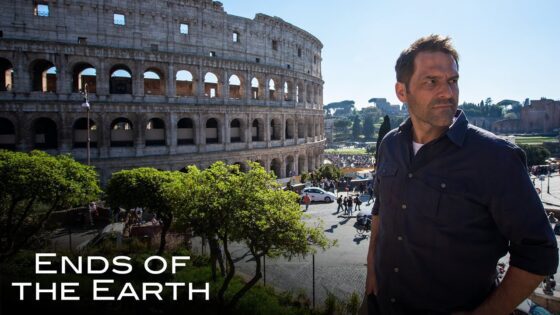
Purchase your DVD today: https://coldwatermedia.com/products-page/
While the rumor was never proven, virtually every significant historian blames the fire on Nero himself – no doubt because of what Nero decided to do afterward. He immediately commandeered huge portions of Rome’s scorched earth to erect one of the biggest, most opulent palaces in all the known world. It’s known as the “Domus Aurea”…or The Golden House.
Nero was also shrewd enough to accuse a scapegoat for the fire to appease the general Roman public. The culprits of choice: the Christians. And blaming them sparked the first great outbreak of state-sponsored persecution that lasted for several years. The Christians were already somewhat of a nuisance. Accused of cannibalism (because they consumed the Lord’s Supper which commemorated the sacrificial body and blood of Jesus) and atheism (because they refused to bow to the Roman gods — including the Caesar). So for Nero…they were the perfect target.
An ancient non-Christian Roman historian alive at the time, named Tacitus, mentions the persecution in his “Annals”. This is what he wrote…
Nero falsely accused and executed with the most exquisite punishments those people called Christians, who were infamous for their abominations. The originator of the name, Christ, was executed as a criminal by the procurator Pontius Pilate during the reign of Tiberius; and though repressed, this destructive superstition erupted again, not only through Judea, which was the origin of this evil, but also through the city of Rome, first those were seized who admitted their faith, and then, using the information they provided, a vast multitude were convicted, not so much for the crime of burning the city, but for hatred of the human race. And perishing they were additionally made into sports: they were killed by dogs by having the hides of beasts attached to them, or they were nailed to crosses or set aflame, and, when the daylight passed away, they were used as nighttime lamps. Even though they were clearly guilty, people began to pity these sufferers, because they were consumed not for the public good but on account of the fierceness of one man.
One such martyr who was killed by crucifixion was a prominent Apostle named Peter, who had become head of the church in Rome. Considering himself to be unworthy to experience the same death as Jesus, Peter requested to be crucified upside-down. Another Apostle, one of Christianity’s most influential because he wrote almost half of the NT, Paul, was also martyred during Nero’s persecution. But since Paul was a Roman citizen, he was exempt from the torture of crucifixion and was beheaded instead.
Nero’s persecution, while bloody and unspeakably cruel, quite simply…backfired. Not only was there growing sympathy for the suffering Christians, their worldview and beliefs were brought into the limelight. Countless Romans witnessed these believers endure ghastly torture rather than recant their faith in Christ as Lord and His resurrection from the dead. Christian tradition holds that, except for John, all of Jesus’ apostles were executed for their faith. For many Christians, this is a strong argument for their truth of their claims. The Apostles, because they were eyewitnesses, knew for certain whether Jesus’ resurrection was true or false. This set them apart. History is full of people willing to die for what they believe. But it is difficult to find any sane person who gave their life for a cause they knew to be fraudulent. Those who defend the Christian faith ask this question: how likely was it that a man would choose torture and death if all he had to do was simply deny a myth?
So the growth of this great world religion was fueled by the blood of its saints — all because of a fire at a racetrack. And Nero, after hearing of an assassination plot, committed suicide by stabbing himself in the throat. His legacy then drifted into history — and even today, he is considered to be one of Rome’s worst Caesars.





























Be the first to comment